
A dangerous tree rarely announces itself in a dramatic way. It usually starts with a few warning signs.
A dead limb hangs over the roof. A trunk starts to crack. The tree leans more after a storm. Roots push up from the soil. A hollow spot gets larger every year. Then one strong storm turns those signs into real damage.
Homeowners in Virginia deal with this often. Mature shade trees stand close to homes, garages, sidewalks, and driveways. They add value and comfort to a yard, but age, storm damage, decay, and poor structure can turn them into a risk.
The good news is simple. A lot of dangerous trees show visible signs before failure. If you know what to watch for, you can act early and avoid a larger problem.
Dead limbs in the canopy
Dead branches are one of the clearest warning signs. A dead limb has lost strength. It dries out, becomes brittle, and breaks more easily during wind or heavy rain.
Some dead branches are small. Others are large enough to damage a roof, crush a fence, or block a driveway. A lot of homeowners do not notice them until leaves drop or a storm twists the canopy.
Look for limbs with no buds, no leaves in season, peeling bark, and dry wood. These branches need removal. They will not recover.
Deadwood near walkways, play areas, driveways, and rooflines deserves quick attention.
A tree that starts to lean
A slight natural lean is not always a problem. A new lean is different.
If a tree begins leaning after a storm, heavy rain, or visible soil movement, treat that as a warning. Trees often lean more once roots start failing. Soft ground, erosion, and root decay can all weaken the base.
Check the soil around the trunk. Do you see lifted roots. Is the ground cracked on one side. Does the trunk look more angled than it did last season.
A tree that leans toward a house, fence, parked cars, or power service lines needs a closer look fast. The direction of the fall zone matters as much as the lean itself.
Cracks in the trunk or major limbs
The trunk carries the full load of the tree. Large limbs carry heavy weight too. Cracks in either area can point to structural failure.
Some cracks stay shallow. Others run deep into the wood. Vertical cracks often show stress. Split branch unions often show weak attachment. Both create danger during wind events.
Look closely after storms. A fresh split may show light wood under the bark. A wider crack may open and close with movement on windy days. That is not something to ignore.
Trees do not repair major structural cracks in a fast or simple way. A trained inspection helps determine whether pruning, support, or removal is the right call.
Root problems at the base
Roots hold the tree in place. When the root system fails, the whole tree becomes unstable.
Property owners often miss root trouble. The canopy gets all the attention. The base of the tree tells a big part of the story. Look for exposed roots, fungus at the base, soft ground, lifted soil, or fresh movement around the trunk flare.
Construction damage matters too. Cutting roots for driveways, trench work, or grading can weaken a tree long before the canopy shows clear symptoms.
Root failure is one reason a tree can look healthy from a distance and still fall without much warning.
Hollow or decayed wood
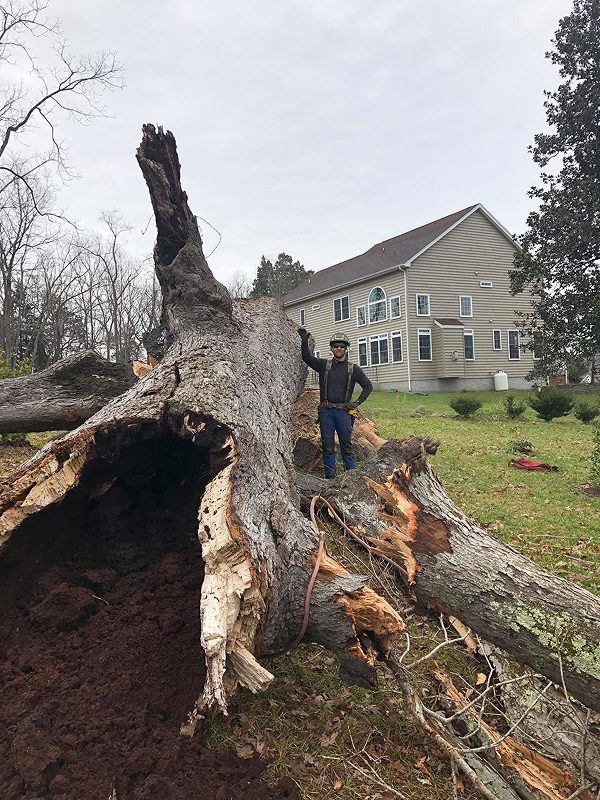
A tree can keep leaves and still have major internal decay. That is what makes decay tricky.
A hollow trunk, soft wood, cavities, or fungus growth can point to internal breakdown. The outside bark may still look mostly normal. The wood inside carries less strength than it should.
Small cavities do not always mean immediate removal. Large hollow sections near the base, major decay in the trunk, or soft wood around structural branch unions raise the risk fast.
The location of the decay matters. A decayed tree in an open field is one thing. A decayed tree ten feet from the house is another.
Heavy limbs over the roof
Long limbs over a roof are a common residential problem. The branch may be alive and still create risk. Length, weight, and poor angle all matter.
A heavy branch gains more load after rain. Wind pushes it harder. If the attachment point is weak, the limb can split without much notice. Roofs, gutters, and porch structures often take the hit.
This is a good area for a simple question. What would this branch hit if it failed tonight? The answer tells you how urgent the issue is.
If the answer is roof, driveway, deck, or power service line, schedule an inspection soon.
Storm damage that does not look dramatic
Not all storm damage is obvious. A tree does not have to fall in full to become unsafe.
A storm can twist a main limb, crack a union high in the canopy, strip bark, or shift the root plate. The tree may still stand. The danger may still be real. Some storm damage shows up days or weeks later as leaves wilt, limbs die back, or the trunk begins to split.
That is why post-storm inspections matter. A crew can spot damage a property owner may miss from the ground.
What homeowners should do next
Do not rush to cut a dangerous tree on your own. Large limbs under tension move fast. Leaning trees shift. Storm-damaged wood does not behave in a predictable way.
Start with distance. Keep people, pets, and parked cars away from the area if possible. Look from the ground. Take note of lean, cracks, deadwood, root movement, and fall direction.
Then get the tree inspected. A trained crew can decide whether pruning solves the issue or whether removal is the safer route. Some trees can stay with proper correction. Others have moved past that point.
The right call protects the house, the yard, and the people who use the space every day.
Closing
Dangerous trees often show warning signs before they fail. Dead limbs, new lean, trunk cracks, root movement, hollow wood, and storm damage all deserve attention. The earlier you catch those signs, the more control you keep over the outcome.
For homeowners in Fredericksburg and nearby areas, regular inspection matters most near homes, garages, driveways, and utility access points. The tree does not need to be dead to become a threat. It only needs one weak point in the wrong place.